work
about

resume

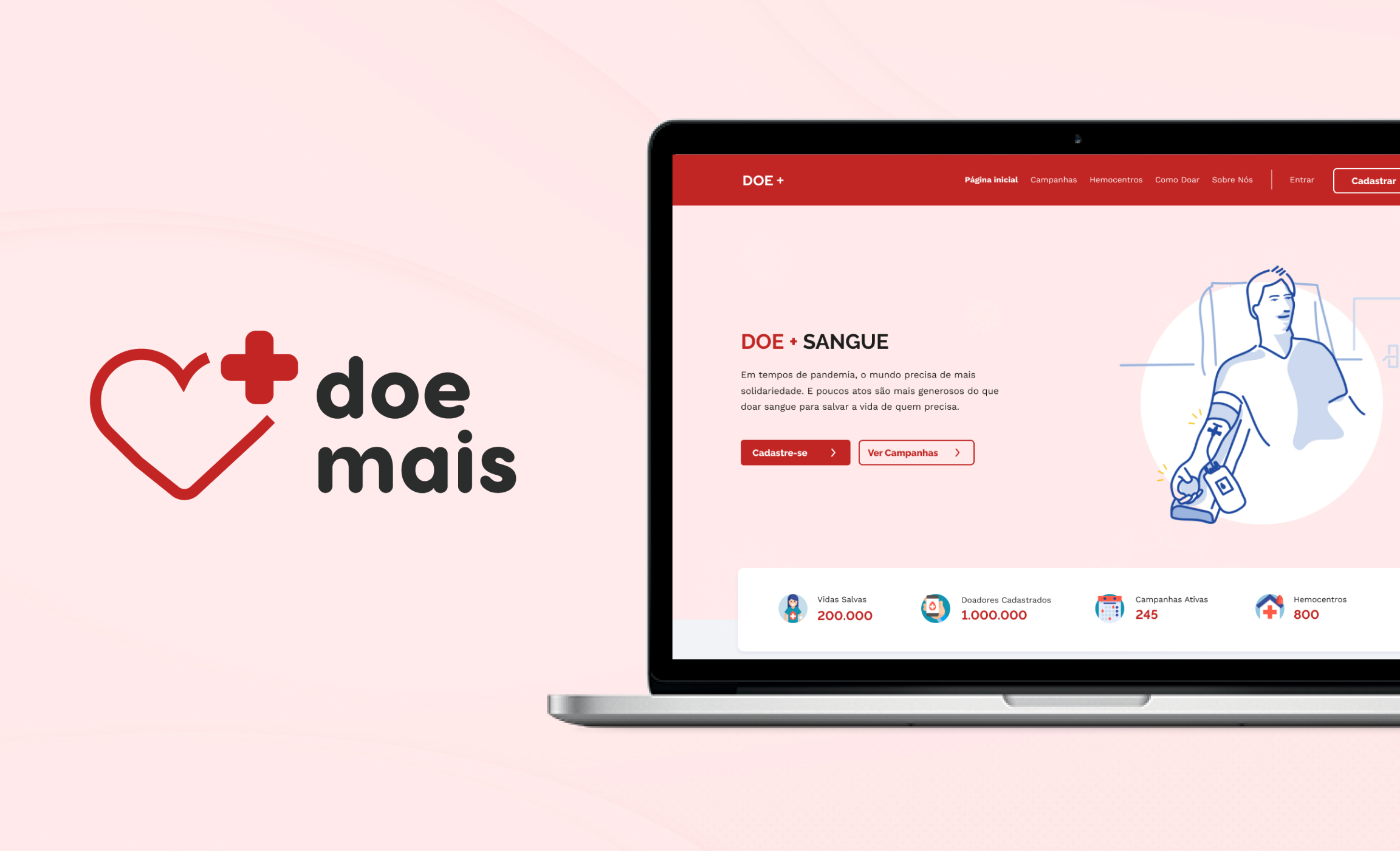
Doe Mais: An Initiative to Save Lives
delivered in March of 2021
Team
Amanda Lira, Karla Santacruz, Ohana Fiori, Nathália Miguel and Vanessa Alves.
The objective of this project is to develop a solution addressing the problems and difficulties related to blood donation in Brazil. To provide some context, below are the three most critical points in the country regarding blood donations:
- Blood banks frequently experience low stock due to a lack of donors.
- In Brazil, only 1.8% of the population donates blood annually, according to data from Fundação Pró-Sangue, the largest blood center in Latin America. The WHO (World Health Organization) recommends that 3.5% to 5% of the population donate.
- With the rise in COVID-19 cases in Brazil in 2020, blood donations saw a 15% to 20% drop in total donations compared to 2019.
Project Stages
#1
Brazilian Market Study: This involves understanding who blood donors are in Brazil and how the country approaches blood collection.
#2
Strategy and Qualitative User Research: We'll dive deep into the reasons why people have never donated blood, and also analyze the reality within blood centers.
#3
Experience Design and Platform Prototype: With all the data gathered, we'll develop wireframes, flowcharts, high-fidelity prototypes, and conduct usability tests.
#4
Workshop with Users: We'll seek to understand the perceptions of recurring blood donors to refine certain aspects of our strategy.
Our First Step: Who Are Blood Donors in Brazil?
To better understand the blood donation landscape in Brazil, we conducted desk research on donor data, the state of blood banks, and the frequency of informative campaigns on the topic. We observed a very low number of donors: only 1.8% of Brazil's population donates blood annually, with 75% of them being low-income and the majority (78%) being men.
With this data, we delved into a quantitative study to understand the reasons for non-donation or one-time donations, the barriers faced by people who want to donate but have never actually visited a blood center in their city, and whether sufficient information was available to encourage the public to donate blood.
We focused on collecting data such as age group and gender, which had emerged in our desk research. Our goal with the quantitative research was to understand why people donate blood, why they don't, and if they were aware of the minimum requirements for donation. Additionally, it was crucial to know if there were common reasons among non-donors, so we included an open-ended question for participants to freely express themselves.
Qualitative Research: Unpacking Perceptions and Professional Insights
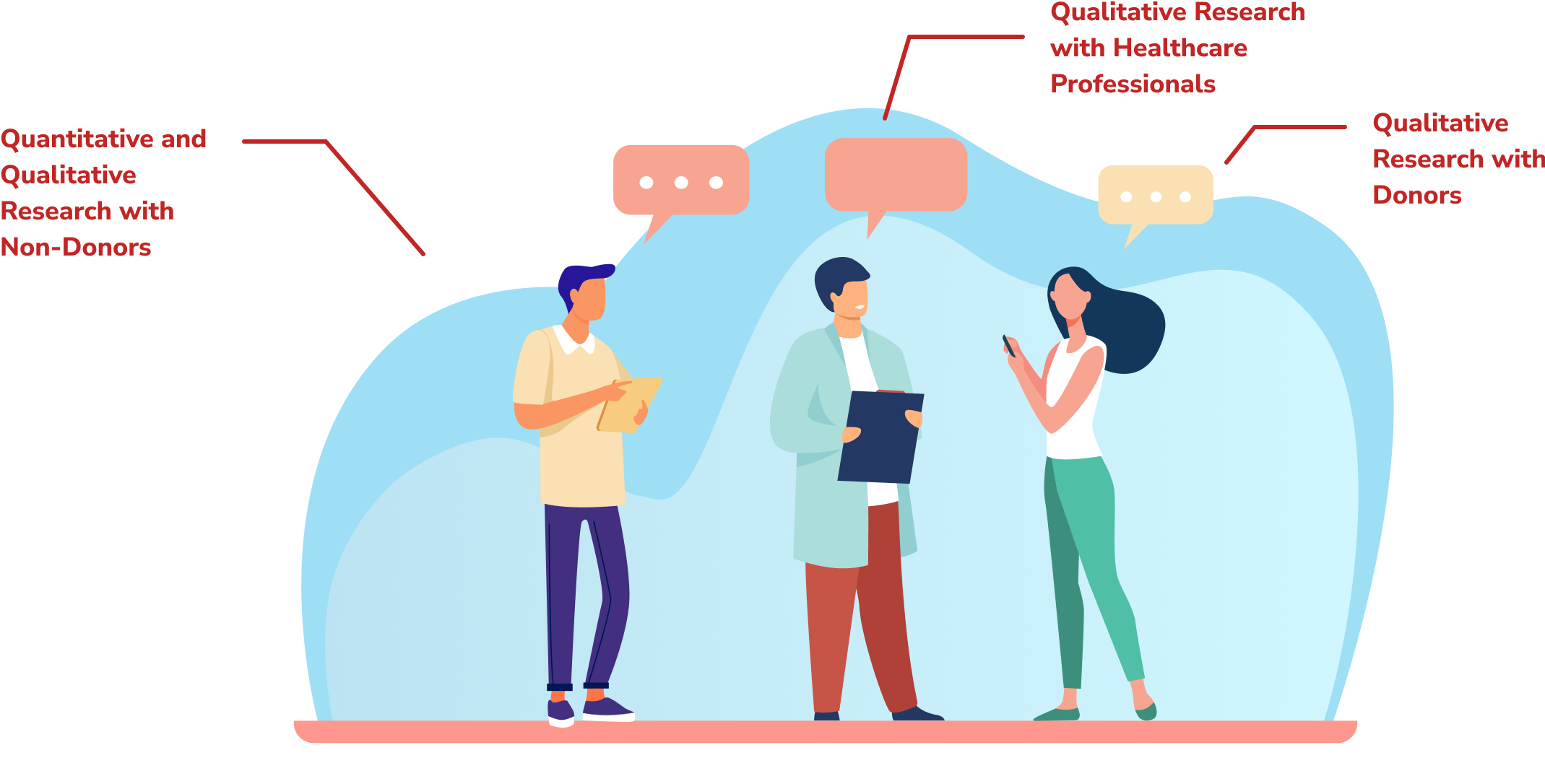
Subsequently, we conducted qualitative research through in-person interviews. Our objective was to understand fears and insecurities, why individuals had never donated, and what information they already knew about the screening process.
The research was exploratory and divided into two distinct phases: one with donors and another with professionals. This approach allowed us to gain different perspectives within the same context. We selected four donors to discuss their experiences with donation campaigns, their motivations for donating, and what areas for improvement they perceived within the process.
Next, we spoke with seven healthcare professionals who work or have worked in blood centers and have contact with donors and the blood donation process. We wanted to understand their routines and what improvements they saw in the screening and donation process. We also gained a better understanding of the impacts the pandemic has had on blood banks since March 2020.
The professionals raised issues such as the lack of safety equipment (like gloves, for example), a deficit of information about the screening process, and the requirements for donation. Another point raised by professionals was the lack of public campaigns for blood donation. According to their reports, professionals believe there's insufficient information about how blood is collected and what happens to the blood bag after collection, which deters people who have never donated blood.

The research generally showed us what the public thinks, sees, says, and does. This helped us build an empathy map highlighting the main points that prevent users from donating (fear of needles, lack of information, and not knowing donation locations) and what they need to become potential donors (available information and less bureaucratic processes).
Benchmarking of key players and related areas
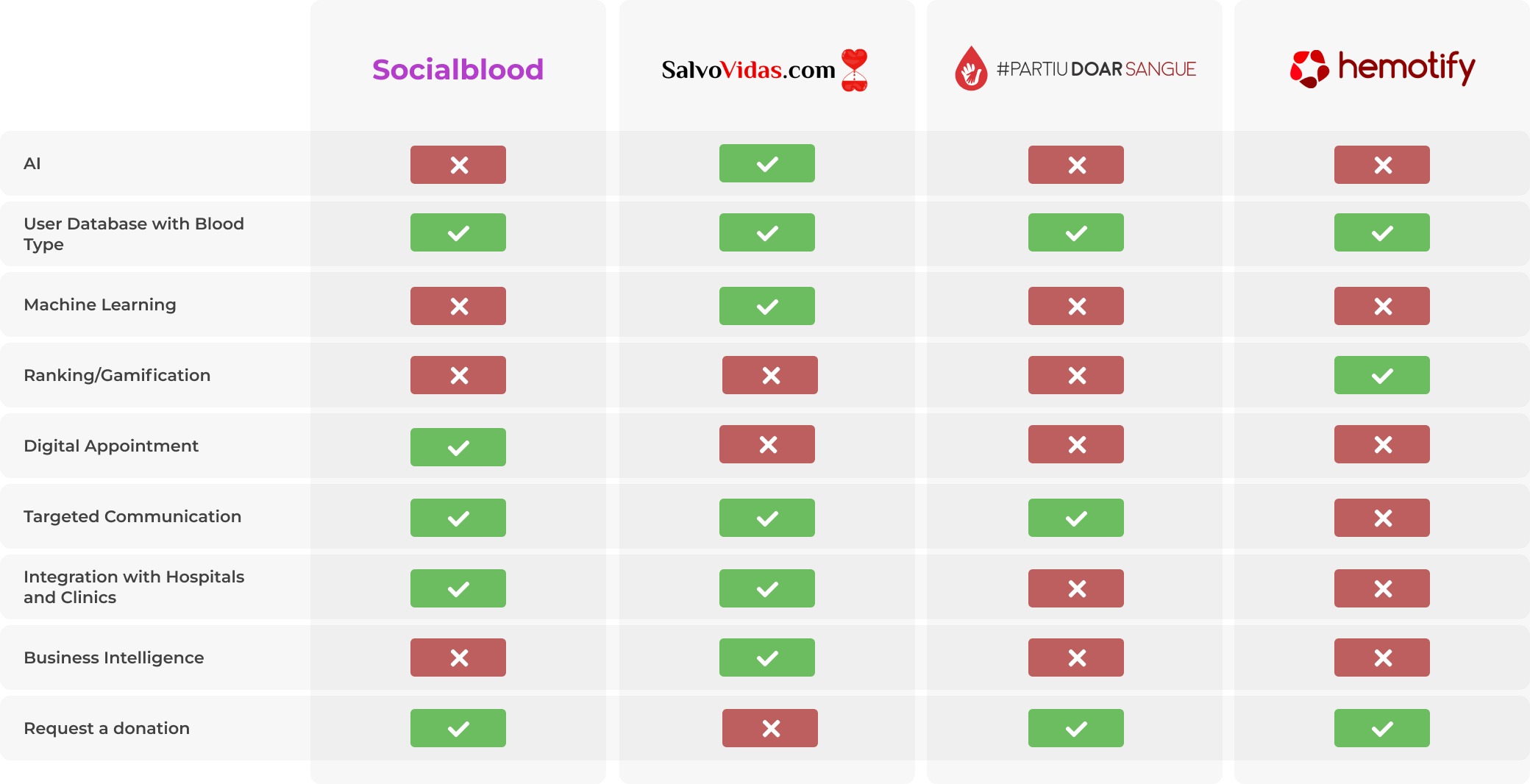
The market offers very few solutions that meet all user needs, and these aren't well-publicized. We analyzed the main players in the blood donation market, such as SalvoVidas and #PartiuDoarSangue, as well as some healthcare players like Dr. Consulta, Klivo, and the startup Alice. We considered aspects such as their area of operation, main competitive differentiators, and number of users.
Some of these projects were discontinued, while others offer interesting insights, such as the use of Machine Learning, which could help us distribute personalized donation requests. However, we noticed this is an area that's barely explored in Brazil.

Our first goal was to develop a solution that would demystify the act of blood donation, making it simple and appealing for people who have never donated. However, this wasn't enough to keep a solution running.
Ever Heard of Named Campaigns?
We noticed a common challenge among those who've needed blood donations at some point: the difficulty in spreading the word among potential donors.
Typically, family and friends share requests on social media for blood bags at a specific hospital, in a particular person's name. These requests aim to replenish the blood supply used by the patient during their hospitalization or medical observation. But the shared problem with these appeals is how tough it is to reach available people, especially those within the city or region of the hospital needing the replenishment. This led us to a key question:
"How can we connect potential donors with people who need blood?"
By demystifying blood donation and providing information about both named campaigns (for specific patients) and collaborative blood center campaigns, along with the locations of blood centers, we found the unique value we wanted to offer users.
Doe Mais: An Initiative to Save Lives
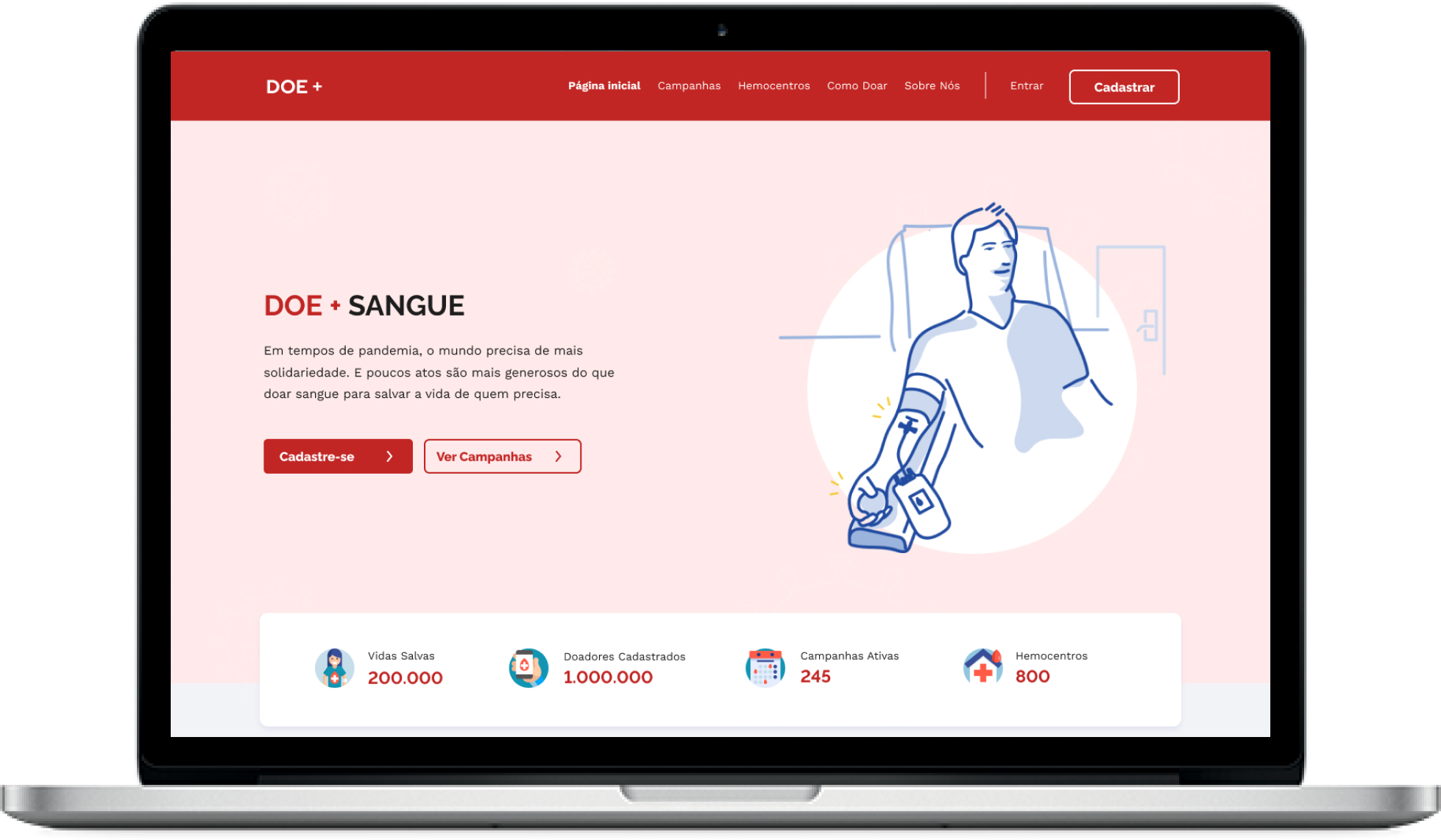
With all the data we gathered and the insights we gained, we developed a platform designed to deliver a complete experience. This platform serves users who need to bring visibility to urgent donation campaigns to save a loved one, as well as those looking to donate for the first time who need detailed information about the process. This is how Doe+ was born.
This platform will address the pain points and needs of users that we mapped. Furthermore, it will also meet the needs of blood centers, easing the critical shortage of donors, especially during this ongoing pandemic.
Doe Mais: An Initiative to Save Lives
With all the data we gathered and the insights we gained, we developed a platform designed to deliver a complete experience. This platform serves users who need to bring visibility to urgent donation campaigns to save a loved one, as well as those looking to donate for the first time who need detailed information about the process. This is how Doe+ was born.
This platform will address the pain points and needs of users that we mapped. Furthermore, it will also meet the needs of blood centers, easing the critical shortage of donors, especially during this ongoing pandemic.
Key Features Developed in the Doe+ Platform:
Named Campaigns and Blood Center Campaigns
For anyone who needs to share any blood donation need, whether for a close relative or for hospital and blood center campaigns.
Eligibility Quiz
This is a multiple-choice test that will inform the user at the end whether they are eligible to donate blood. This will clarify doubts and prevent wasted travel time.
Donation Information Guide
All, or at least most, common questions will be answered in this guide. We mapped that many users avoid donating due to a lack of small details and an inability to find answers.
Donation Requests
Each campaign on the site will notify via email all users with a compatible blood type and who are located closest to the donation site.
Recurrence Reminders
Blood donations can be made every 3 months for men or every 4 months for women. The platform will notify users when they are eligible to donate again after their last appointment.
Blood Center Locations
Some users don't donate because they don't know the collection points. We will provide this information clearly, along with operating hours and active campaigns.
A Donor's Perspective
As the final stage of our creation process, we spoke with recurrent blood donors to understand the challenges they faced during repeated donation experiences.
In a three-hour workshop, four individuals participated, sharing their experiences, opinions, and suggestions. Given the opportunity for co-creation, participants offered ideas to meet their needs, such as knowing when one of their donated blood bags was used, getting directions to blood centers, receiving information on when they could donate again, and other suggestions.
One common point raised by all participants was the queue during the screening process. This could be avoided with pre-registration and scheduling through the platform, making the donation quicker and safer, preventing crowds, or long wait times, which can discourage a potential donor.
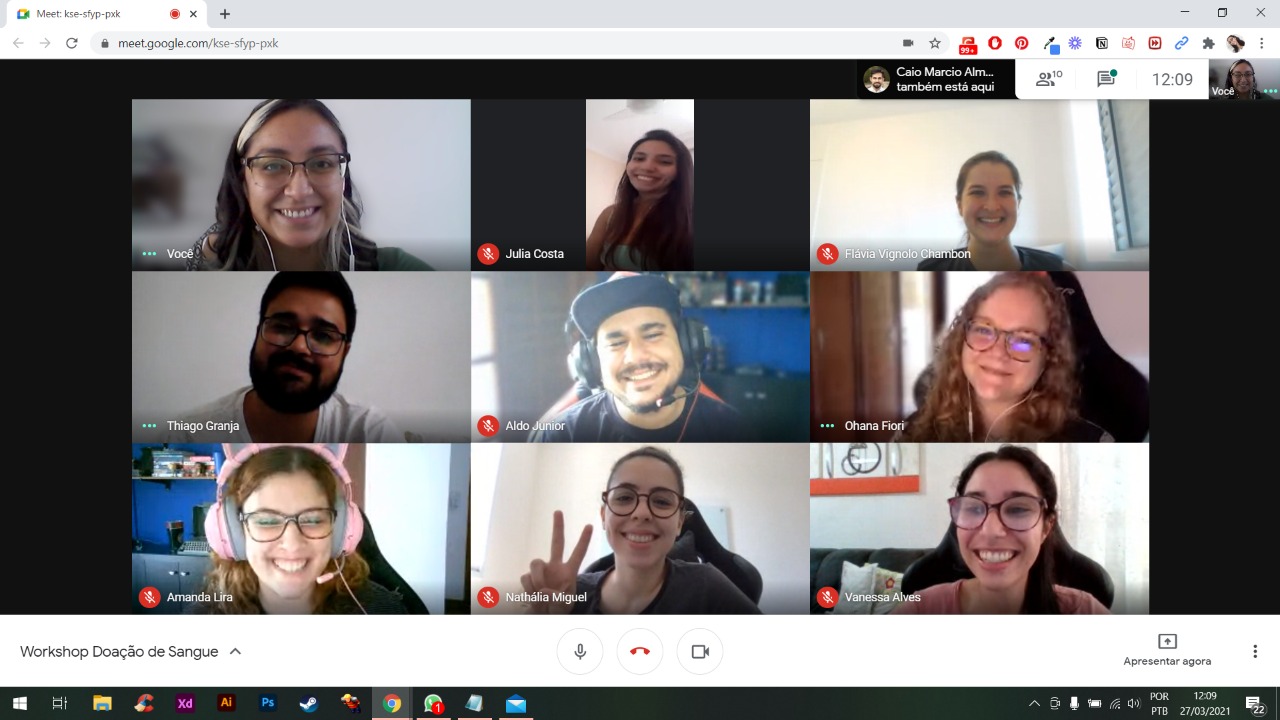
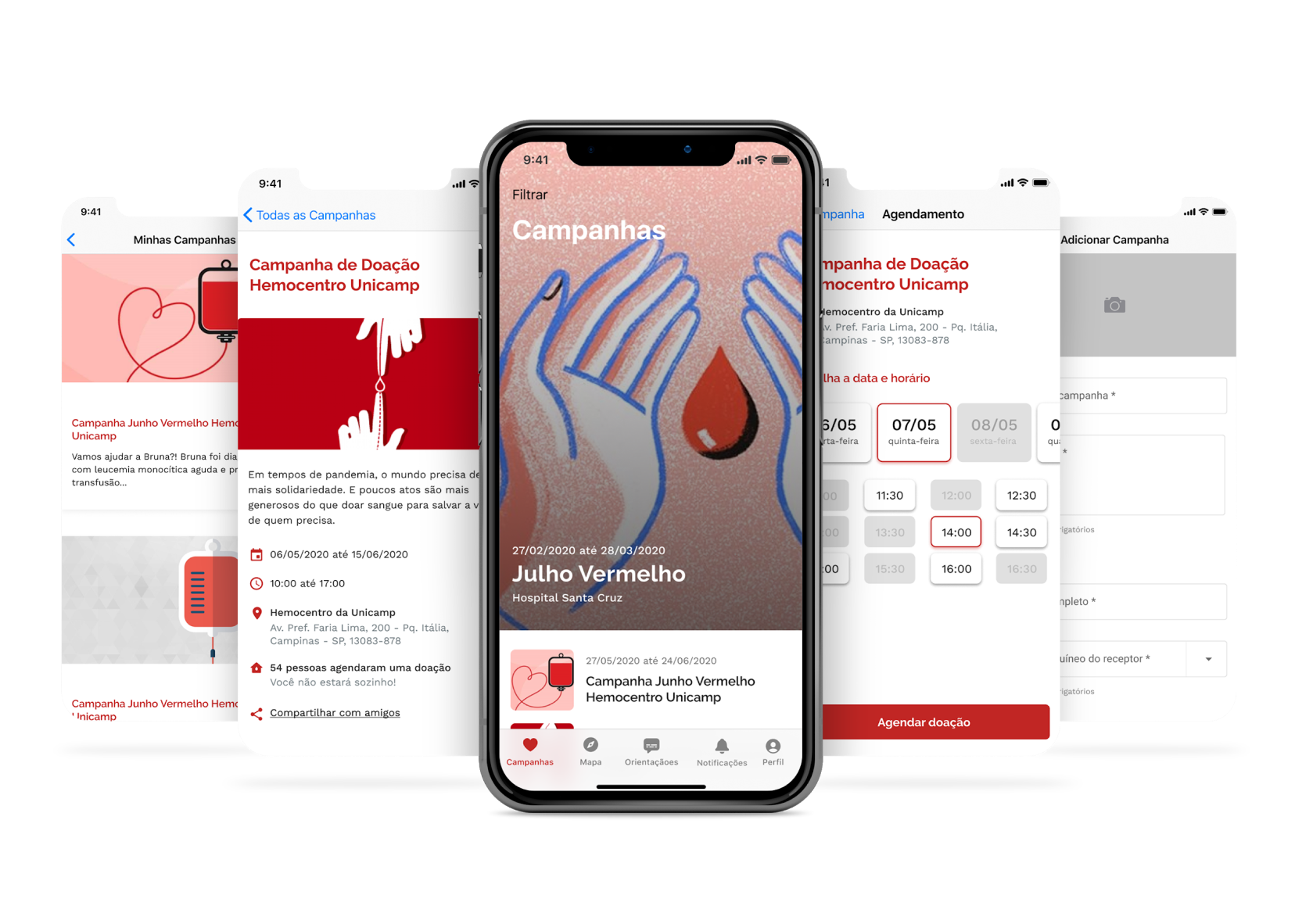
Another suggestion raised during the workshop was the possibility of accessing the platform via a mobile device. This is precisely because mobile is the primary method of internet access, making it easy to schedule appointments or track donations from anywhere without needing a computer.
Many of these alternatives were added to our MVP (Minimum Viable Product), and that's how we developed the solution as a mobile application for scheduling donations at blood centers.
This donor workshop was incredibly valuable for analyzing the perspectives of those who frequently experience the donation process. Hearing from them how we could improve the platform helped us realize we're on the right track, and our solution will help millions of people and potential donors.
Doe+ in the Future
- Alerts when donated blood is used: We'll research with blood centers the possibility of knowing when a blood bag has been used. In the meantime, we'll implement a solution sending emails with informative updates on the impact of their donation.
- Enhance donation recurrence: We'll allow users to personalize their profiles by adding events like getting a piercing or tattoo, undergoing surgery, or donating blood outside the platform's scheduling system. This way, we can send customized alerts informing them when they're eligible to donate again.
- Map routes to blood centers: We'll integrate Google Maps routes to blood center locations.
We believe Doe+ goes beyond being just an informative platform about blood donation. It also becomes a method for acquiring new donors, increasing visibility for campaigns, and streamlining the entire donation tracking process.
This project began in 2020 during our Post-Graduation program at PUC Campinas. It was a year when blood donations were in a critical state across the country due to the pandemic, and we realized how crucial it was to take this initiative.
Encourage, monitor, and inform are our core values. With Doe+, we aim to save many lives and inspire more people to become blood donors in Brazil.
We extend our gratitude to the professors who guided, instructed, and encouraged us throughout the project's development. To everyone who participated in the surveys, interviews, and workshops, you undoubtedly helped us better visualize the entire process both inside and outside blood centers.
And to all who donate or have donated blood, helping to save lives.
Let’s work together :)
work
about
resume

Ohana Fiori.
work
about
resume
Doe Mais: An Initiative to Save Lives
delivered in March of 2021
Team
Amanda Lira, Karla Santacruz, Ohana Fiori, Nathália Miguel and Vanessa Alves.
The objective of this project is to develop a solution addressing the problems and difficulties related to blood donation in Brazil. To provide some context, below are the three most critical points in the country regarding blood donations:
- Blood banks frequently experience low stock due to a lack of donors.
- In Brazil, only 1.8% of the population donates blood annually, according to data from Fundação Pró-Sangue, the largest blood center in Latin America. The WHO (World Health Organization) recommends that 3.5% to 5% of the population donate.
- With the rise in COVID-19 cases in Brazil in 2020, blood donations saw a 15% to 20% drop in total donations compared to 2019.
Project Stages
#1
Brazilian Market Study: This involves understanding who blood donors are in Brazil and how the country approaches blood collection.
#2
Strategy and Qualitative User Research: We'll dive deep into the reasons why people have never donated blood, and also analyze the reality within blood centers.
#3
Experience Design and Platform Prototype: With all the data gathered, we'll develop wireframes, flowcharts, high-fidelity prototypes, and conduct usability tests.
#4
Workshop with Users: We'll seek to understand the perceptions of recurring blood donors to refine certain aspects of our strategy.
Our First Step: Who Are Blood Donors in Brazil?
To better understand the blood donation landscape in Brazil, we conducted desk research on donor data, the state of blood banks, and the frequency of informative campaigns on the topic. We observed a very low number of donors: only 1.8% of Brazil's population donates blood annually, with 75% of them being low-income and the majority (78%) being men.
With this data, we delved into a quantitative study to understand the reasons for non-donation or one-time donations, the barriers faced by people who want to donate but have never actually visited a blood center in their city, and whether sufficient information was available to encourage the public to donate blood.
We focused on collecting data such as age group and gender, which had emerged in our desk research. Our goal with the quantitative research was to understand why people donate blood, why they don't, and if they were aware of the minimum requirements for donation. Additionally, it was crucial to know if there were common reasons among non-donors, so we included an open-ended question for participants to freely express themselves.
Qualitative Research: Unpacking Perceptions and Professional Insights
Subsequently, we conducted qualitative research through in-person interviews. Our objective was to understand fears and insecurities, why individuals had never donated, and what information they already knew about the screening process.
The research was exploratory and divided into two distinct phases: one with donors and another with professionals. This approach allowed us to gain different perspectives within the same context. We selected four donors to discuss their experiences with donation campaigns, their motivations for donating, and what areas for improvement they perceived within the process.
Next, we spoke with seven healthcare professionals who work or have worked in blood centers and have contact with donors and the blood donation process. We wanted to understand their routines and what improvements they saw in the screening and donation process. We also gained a better understanding of the impacts the pandemic has had on blood banks since March 2020.
The professionals raised issues such as the lack of safety equipment (like gloves, for example), a deficit of information about the screening process, and the requirements for donation. Another point raised by professionals was the lack of public campaigns for blood donation. According to their reports, professionals believe there's insufficient information about how blood is collected and what happens to the blood bag after collection, which deters people who have never donated blood.
The research generally showed us what the public thinks, sees, says, and does. This helped us build an empathy map highlighting the main points that prevent users from donating (fear of needles, lack of information, and not knowing donation locations) and what they need to become potential donors (available information and less bureaucratic processes).
Benchmarking of key players and related areas
Key Features Developed in the Doe+ Platform:
Named Campaigns and Blood Center Campaigns
For anyone who needs to share any blood donation need, whether for a close relative or for hospital and blood center campaigns.
Eligibility Quiz
This is a multiple-choice test that will inform the user at the end whether they are eligible to donate blood. This will clarify doubts and prevent wasted travel time.
Donation Information Guide
All, or at least most, common questions will be answered in this guide. We mapped that many users avoid donating due to a lack of small details and an inability to find answers.
Donation Requests
Each campaign on the site will notify via email all users with a compatible blood type and who are located closest to the donation site.
Recurrence Reminders
Blood donations can be made every 3 months for men or every 4 months for women. The platform will notify users when they are eligible to donate again after their last appointment.
Blood Center Locations
Some users don't donate because they don't know the collection points. We will provide this information clearly, along with operating hours and active campaigns.
The market offers very few solutions that meet all user needs, and these aren't well-publicized. We analyzed the main players in the blood donation market, such as SalvoVidas and #PartiuDoarSangue, as well as some healthcare players like Dr. Consulta, Klivo, and the startup Alice. We considered aspects such as their area of operation, main competitive differentiators, and number of users.
Some of these projects were discontinued, while others offer interesting insights, such as the use of Machine Learning, which could help us distribute personalized donation requests. However, we noticed this is an area that's barely explored in Brazil.
Our first goal was to develop a solution that would demystify the act of blood donation, making it simple and appealing for people who have never donated. However, this wasn't enough to keep a solution running.
Ever Heard of Named Campaigns?
We noticed a common challenge among those who've needed blood donations at some point: the difficulty in spreading the word among potential donors.
Typically, family and friends share requests on social media for blood bags at a specific hospital, in a particular person's name. These requests aim to replenish the blood supply used by the patient during their hospitalization or medical observation. But the shared problem with these appeals is how tough it is to reach available people, especially those within the city or region of the hospital needing the replenishment. This led us to a key question:
"How can we connect potential donors with people who need blood?"
By demystifying blood donation and providing information about both named campaigns (for specific patients) and collaborative blood center campaigns, along with the locations of blood centers, we found the unique value we wanted to offer users.
Doe Mais: An Initiative to Save Lives
With all the data we gathered and the insights we gained, we developed a platform designed to deliver a complete experience. This platform serves users who need to bring visibility to urgent donation campaigns to save a loved one, as well as those looking to donate for the first time who need detailed information about the process. This is how Doe+ was born.
This platform will address the pain points and needs of users that we mapped. Furthermore, it will also meet the needs of blood centers, easing the critical shortage of donors, especially during this ongoing pandemic.
Doe Mais: An Initiative to Save Lives
With all the data we gathered and the insights we gained, we developed a platform designed to deliver a complete experience. This platform serves users who need to bring visibility to urgent donation campaigns to save a loved one, as well as those looking to donate for the first time who need detailed information about the process. This is how Doe+ was born.
This platform will address the pain points and needs of users that we mapped. Furthermore, it will also meet the needs of blood centers, easing the critical shortage of donors, especially during this ongoing pandemic.
A Donor's Perspective
As the final stage of our creation process, we spoke with recurrent blood donors to understand the challenges they faced during repeated donation experiences.
In a three-hour workshop, four individuals participated, sharing their experiences, opinions, and suggestions. Given the opportunity for co-creation, participants offered ideas to meet their needs, such as knowing when one of their donated blood bags was used, getting directions to blood centers, receiving information on when they could donate again, and other suggestions.
One common point raised by all participants was the queue during the screening process. This could be avoided with pre-registration and scheduling through the platform, making the donation quicker and safer, preventing crowds, or long wait times, which can discourage a potential donor.
Another suggestion raised during the workshop was the possibility of accessing the platform via a mobile device. This is precisely because mobile is the primary method of internet access, making it easy to schedule appointments or track donations from anywhere without needing a computer.
Many of these alternatives were added to our MVP (Minimum Viable Product), and that's how we developed the solution as a mobile application for scheduling donations at blood centers.
This donor workshop was incredibly valuable for analyzing the perspectives of those who frequently experience the donation process. Hearing from them how we could improve the platform helped us realize we're on the right track, and our solution will help millions of people and potential donors.
Doe+ in the Future
- Alerts when donated blood is used: We'll research with blood centers the possibility of knowing when a blood bag has been used. In the meantime, we'll implement a solution sending emails with informative updates on the impact of their donation.
- Enhance donation recurrence: We'll allow users to personalize their profiles by adding events like getting a piercing or tattoo, undergoing surgery, or donating blood outside the platform's scheduling system. This way, we can send customized alerts informing them when they're eligible to donate again.
- Map routes to blood centers: We'll integrate Google Maps routes to blood center locations.
We believe Doe+ goes beyond being just an informative platform about blood donation. It also becomes a method for acquiring new donors, increasing visibility for campaigns, and streamlining the entire donation tracking process.
This project began in 2020 during our Post-Graduation program at PUC Campinas. It was a year when blood donations were in a critical state across the country due to the pandemic, and we realized how crucial it was to take this initiative.
Encourage, monitor, and inform are our core values. With Doe+, we aim to save many lives and inspire more people to become blood donors in Brazil.
We extend our gratitude to the professors who guided, instructed, and encouraged us throughout the project's development. To everyone who participated in the surveys, interviews, and workshops, you undoubtedly helped us better visualize the entire process both inside and outside blood centers.
And to all who donate or have donated blood, helping to save lives.
Let’s work together :)
work
about
resume
Ohana Fiori.
work
about
resume
Doe Mais: An Initiative to Save Lives
delivered in March of 2021
Team
Amanda Lira, Karla Santacruz, Ohana Fiori, Nathália Miguel and Vanessa Alves.
The objective of this project is to develop a solution addressing the problems and difficulties related to blood donation in Brazil. To provide some context, below are the three most critical points in the country regarding blood donations:
- Blood banks frequently experience low stock due to a lack of donors.
- In Brazil, only 1.8% of the population donates blood annually, according to data from Fundação Pró-Sangue, the largest blood center in Latin America. The WHO (World Health Organization) recommends that 3.5% to 5% of the population donate.
- With the rise in COVID-19 cases in Brazil in 2020, blood donations saw a 15% to 20% drop in total donations compared to 2019.
Project Stages
#1
Brazilian Market Study: This involves understanding who blood donors are in Brazil and how the country approaches blood collection.
#2
Strategy and Qualitative User Research: We'll dive deep into the reasons why people have never donated blood, and also analyze the reality within blood centers.
#3
Experience Design and Platform Prototype: With all the data gathered, we'll develop wireframes, flowcharts, high-fidelity prototypes, and conduct usability tests.
#4
Workshop with Users: We'll seek to understand the perceptions of recurring blood donors to refine certain aspects of our strategy.
Our First Step: Who Are Blood Donors in Brazil?
To better understand the blood donation landscape in Brazil, we conducted desk research on donor data, the state of blood banks, and the frequency of informative campaigns on the topic. We observed a very low number of donors: only 1.8% of Brazil's population donates blood annually, with 75% of them being low-income and the majority (78%) being men.
With this data, we delved into a quantitative study to understand the reasons for non-donation or one-time donations, the barriers faced by people who want to donate but have never actually visited a blood center in their city, and whether sufficient information was available to encourage the public to donate blood.
We focused on collecting data such as age group and gender, which had emerged in our desk research. Our goal with the quantitative research was to understand why people donate blood, why they don't, and if they were aware of the minimum requirements for donation. Additionally, it was crucial to know if there were common reasons among non-donors, so we included an open-ended question for participants to freely express themselves.
Qualitative Research: Unpacking Perceptions and Professional Insights
Subsequently, we conducted qualitative research through in-person interviews. Our objective was to understand fears and insecurities, why individuals had never donated, and what information they already knew about the screening process.
The research was exploratory and divided into two distinct phases: one with donors and another with professionals. This approach allowed us to gain different perspectives within the same context. We selected four donors to discuss their experiences with donation campaigns, their motivations for donating, and what areas for improvement they perceived within the process.
Next, we spoke with seven healthcare professionals who work or have worked in blood centers and have contact with donors and the blood donation process. We wanted to understand their routines and what improvements they saw in the screening and donation process. We also gained a better understanding of the impacts the pandemic has had on blood banks since March 2020.
The professionals raised issues such as the lack of safety equipment (like gloves, for example), a deficit of information about the screening process, and the requirements for donation. Another point raised by professionals was the lack of public campaigns for blood donation. According to their reports, professionals believe there's insufficient information about how blood is collected and what happens to the blood bag after collection, which deters people who have never donated blood.
The research generally showed us what the public thinks, sees, says, and does. This helped us build an empathy map highlighting the main points that prevent users from donating (fear of needles, lack of information, and not knowing donation locations) and what they need to become potential donors (available information and less bureaucratic processes).
Benchmarking of key players and related areas
The market offers very few solutions that meet all user needs, and these aren't well-publicized. We analyzed the main players in the blood donation market, such as SalvoVidas and #PartiuDoarSangue, as well as some healthcare players like Dr. Consulta, Klivo, and the startup Alice. We considered aspects such as their area of operation, main competitive differentiators, and number of users.
Some of these projects were discontinued, while others offer interesting insights, such as the use of Machine Learning, which could help us distribute personalized donation requests. However, we noticed this is an area that's barely explored in Brazil.
Our first goal was to develop a solution that would demystify the act of blood donation, making it simple and appealing for people who have never donated. However, this wasn't enough to keep a solution running.
Ever Heard of Named Campaigns?
We noticed a common challenge among those who've needed blood donations at some point: the difficulty in spreading the word among potential donors.
Typically, family and friends share requests on social media for blood bags at a specific hospital, in a particular person's name. These requests aim to replenish the blood supply used by the patient during their hospitalization or medical observation. But the shared problem with these appeals is how tough it is to reach available people, especially those within the city or region of the hospital needing the replenishment. This led us to a key question:
"How can we connect potential donors with people who need blood?"
By demystifying blood donation and providing information about both named campaigns (for specific patients) and collaborative blood center campaigns, along with the locations of blood centers, we found the unique value we wanted to offer users.
Doe Mais: An Initiative to Save Lives
With all the data we gathered and the insights we gained, we developed a platform designed to deliver a complete experience. This platform serves users who need to bring visibility to urgent donation campaigns to save a loved one, as well as those looking to donate for the first time who need detailed information about the process. This is how Doe+ was born.
This platform will address the pain points and needs of users that we mapped. Furthermore, it will also meet the needs of blood centers, easing the critical shortage of donors, especially during this ongoing pandemic.
Doe Mais: An Initiative to Save Lives
With all the data we gathered and the insights we gained, we developed a platform designed to deliver a complete experience. This platform serves users who need to bring visibility to urgent donation campaigns to save a loved one, as well as those looking to donate for the first time who need detailed information about the process. This is how Doe+ was born.
This platform will address the pain points and needs of users that we mapped. Furthermore, it will also meet the needs of blood centers, easing the critical shortage of donors, especially during this ongoing pandemic.
Key Features Developed in the Doe+ Platform:
Named Campaigns and Blood Center Campaigns
For anyone who needs to share any blood donation need, whether for a close relative or for hospital and blood center campaigns.
Eligibility Quiz:
This is a multiple-choice test that will inform the user at the end whether they are eligible to donate blood. This will clarify doubts and prevent wasted travel time.
Donation Information Guide
All, or at least most, common questions will be answered in this guide. We mapped that many users avoid donating due to a lack of small details and an inability to find answers.
Donation Requests
Each campaign on the site will notify via email all users with a compatible blood type and who are located closest to the donation site.
Recurrence Reminders
Blood donations can be made every 3 months for men or every 4 months for women. The platform will notify users when they are eligible to donate again after their last appointment.
Blood Center Locations
Some users don't donate because they don't know the collection points. We will provide this information clearly, along with operating hours and active campaigns.
A Donor's Perspective
As the final stage of our creation process, we spoke with recurrent blood donors to understand the challenges they faced during repeated donation experiences.
In a three-hour workshop, four individuals participated, sharing their experiences, opinions, and suggestions. Given the opportunity for co-creation, participants offered ideas to meet their needs, such as knowing when one of their donated blood bags was used, getting directions to blood centers, receiving information on when they could donate again, and other suggestions.
One common point raised by all participants was the queue during the screening process. This could be avoided with pre-registration and scheduling through the platform, making the donation quicker and safer, preventing crowds, or long wait times, which can discourage a potential donor.
Another suggestion raised during the workshop was the possibility of accessing the platform via a mobile device. This is precisely because mobile is the primary method of internet access, making it easy to schedule appointments or track donations from anywhere without needing a computer.
Many of these alternatives were added to our MVP (Minimum Viable Product), and that's how we developed the solution as a mobile application for scheduling donations at blood centers.
This donor workshop was incredibly valuable for analyzing the perspectives of those who frequently experience the donation process. Hearing from them how we could improve the platform helped us realize we're on the right track, and our solution will help millions of people and potential donors.
Doe+ in the Future
- Alerts when donated blood is used: We'll research with blood centers the possibility of knowing when a blood bag has been used. In the meantime, we'll implement a solution sending emails with informative updates on the impact of their donation.
- Enhance donation recurrence: We'll allow users to personalize their profiles by adding events like getting a piercing or tattoo, undergoing surgery, or donating blood outside the platform's scheduling system. This way, we can send customized alerts informing them when they're eligible to donate again.
- Map routes to blood centers: We'll integrate Google Maps routes to blood center locations.
We believe Doe+ goes beyond being just an informative platform about blood donation. It also becomes a method for acquiring new donors, increasing visibility for campaigns, and streamlining the entire donation tracking process.
This project began in 2020 during our Post-Graduation program at PUC Campinas. It was a year when blood donations were in a critical state across the country due to the pandemic, and we realized how crucial it was to take this initiative.
Encourage, monitor, and inform are our core values. With Doe+, we aim to save many lives and inspire more people to become blood donors in Brazil.
We extend our gratitude to the professors who guided, instructed, and encouraged us throughout the project's development. To everyone who participated in the surveys, interviews, and workshops, you undoubtedly helped us better visualize the entire process both inside and outside blood centers.
And to all who donate or have donated blood, helping to save lives.
Let’s work together :)
work
about
resume
